The ‘ger’ was expected to do what??

We’ve discussed ‘one law for all.’  Honestly, the alien/sojourner, the ger who joined him/herself to Israel is expected to do it all…  Look at this list of requirements from the Torah:

  • Keep the Sabbath (Ex. 20:10; Deu. 5:14)  (Targumim translate ‘within your gates’ as ‘in your cities/towns’)
  • Observe Pesach (Ex. 12:48-49)
  • Observe Feast of Unleavened/Chag HaMotzot  (Ex. 12:19) or be ‘cut off.’
  • Observe Shavuot (Deu. 16:10-11)
  • Observe Yom Kippur (Lev. 16:29)
  • Observe Sukkot (Deu. 16:13-14) (Same note as above on Targumim)
  • Participate in sacrifices (Lev. 17:8-9; 22:17-18, 31; Num. 15:14-16)
  • Observe all laws of purity!!  (Lev. 17:12, 15; 18:26; Num. 19:10;  (Proper observance of sacrifices and festivals required ritual purity!)
  • Obey moral laws (Lev. 24:16; Num. 15:14-16, 26, 29-30)

NOTE:  I was going to put an asterisk next to each verse where the Chumash incorrectly translates ger as ‘proselyte’ or ‘convert,’ but after looking all of them up I realized that at least they were consistent in their bias.  All of the preceding verses cited incorrectly translate ger. In doing so, they ‘anachronistically’ apply Second Temple Judaic proselyte conversion to the ger of the Torah, thus ‘adding’ to the Word of God.  But, we have written about that.  Hardly a… nuance.

But, there is hope.  Maybe the translators of the Chumash got tired or careless….  They got it right near the end of the Torah: Continue reading “The ‘ger’ was expected to do what??”

The solid Rock of…. the Rabbis?!?

I’m on whopping page 39 of Tim Hegg’s shifting-sandFellow Heirs and already have dozens of margin notes and thoughts.  While some come directly from his writing, others  not necessarily related to his topic have been generated  by something he says.  This is one of those thoughts…

Now, before I lay this thought out there, I have to state clearly, I am NOT unfairly addressing the Rabbis.  I am an “equal opportunity offender” and have dressed down many Christian theologians, Reformers, translators and doctrines. So, in addressing something with the Rabbis, it is not personal, just the business of seeking truth!  Fair?

Hegg, on page 21 said,

The Sages, following the destruction of the Temple, ruled that in lieu of the sacrifice an equivalent payment of money was required: “Our Rabbis taught: A proselyte in these days has to put aside a fourth [of a denar] for his sacrifice of birds.  Said R. Simeon: R. Johanan b. Zakkai held a vote on this rule and abolished it for fear of misuse.  Said R. Idi b. Gershom in the name of R. Adda son of Ahaba, The decision is according to R. Simeon.”   Once again, the fact that a Sage of the stature of Johanan B. Zakkai should seek to abolish the halachah because he saw it as potentially dangerous, should tell us that this requirement was also in some state of flux before the destruction of the Temple.  [Rabbinic quote footnoted from b. Keritot 9a in Fellow Heirs, by Tim Hegg]

Those two mentions of ‘abolish’ in regard to halachah hit me like a bolt of lightning!  Of course!  Halachah can change and is therefore Continue reading “The solid Rock of…. the Rabbis?!?”

Tales from the Bus. Wilfredo.

I got emotional this morning as I picked up a new 2nd or 3rd grade passenger, a smiling chap named Wilfredo.0ebe777a684f562898a53431348553af

Just yesterday afternoon, the second day of school, I was introduced to this young immigrant from Guatemala who speaks not a word of English!  Apparently, the previous day he had accidentally gotten on the wrong bus and had no clue how to communicate anything, never-mind his new address, etc to the new bus driver.  After he wound up at the bus office with frantic parents and school officials trying to sort the situation, you can imagine why yesterday the whole family was standing in front of the house, visibly relieved, when I dropped him off at the right place and time.  Smiles, waving and the littlest children leaping for joy.  Wilfredo was home!!!

I was an immigrant once.  Growing up as the eldest son of missionaries in the jungles of South America, I remember not knowing anyone, the language, culture, etc.  I learned, but it took time and I never felt like I fit in.  Even today, being a ‘third culture kid,’ I never feel quite like I fit in, so my heart really went out to Wilfredo as he boarded my bus.  Brave!

“Buenos dias, Como le va?” I greeted and he replied, amazed as are a few other Hispanics on my bus that I speak semi-fluent Spanish with a correct accent.  I am so glad that I can help him adjust and feel safe and secure in this transition.

After I dropped him off, as we began rolling I was suddenly overwhelmed with emotion Continue reading “Tales from the Bus. Wilfredo.”

The ‘ger,’ the Chumash and Anachronism

anach·ro·nism  noun ə-ˈna-krə-ˌni-zəm

: something (such as a word, an object, or an event) that is mistakenly placed in a time where it does not belong in a story, movie, etc.

: a person or a thing that seems to belong to the past and not to fit in the present

Full Definition of ANACHRONISMMerriam Webster Dictionary

1:  an error in chronology; especially :  a chronological misplacing of persons, events, objects, or customs in regard to each other
2:  a person or a thing that is chronologically out of place; especially :  one from a former age that is incongruous in the present
3:  the state or condition of being chronologically out of place  Merriam-Webster Dictionary

In one of the ongoing blog discussions that I participate in concerning the Torah and its applicability today in the lives of non-Jewish believers, a friend likes to point out ‘anachronisms,’ or, as he might phrase it, ‘an improper application of a commandment given in one time period by a person or group in another time period.’

Lately, one of the topics has been ‘One Law’ as explained by JK McKee in his recently reviewed book titled One Law for All, and a major point of discussion is whether the commandments concerning the ‘ger’ have any relevance today.  In fact, my friend, James, says, Continue reading “The ‘ger,’ the Chumash and Anachronism”

…Mourn with those who mourn.

Romans 12:15 (NIV) “…mourn with those who mourn.”

For the last ten years or so, 9/11 has been a day of remembrance and sorrow.  Nationally, 522px-North_face_south_tower_after_plane_strike_9-11we cannot forget that date.  It is forever burned in the memories of any who watched, and we have told our children who may not have witnessed the horror.

Imagine for a moment if, against massive statistical odds, we could look back at numerous disasters that fell on that same date: 9/11!  How then, as a people would we feel about that date?  What if the combined deaths from those tragedies, always on (or very near) that date, totaled in the tens of millions?  Blackness.  Grief.  Mourning!

There is such a date, and it begins at sundown tonight.  It is Tisha B’Av, or ‘the ninth of Av.’

Against all statistical odds, this date has proved more disastrous for the Jewish people than any other date in history! On this day,

  • 587 BCE Solomon’s Temple breached and burned/destroyed by the Babylonians.
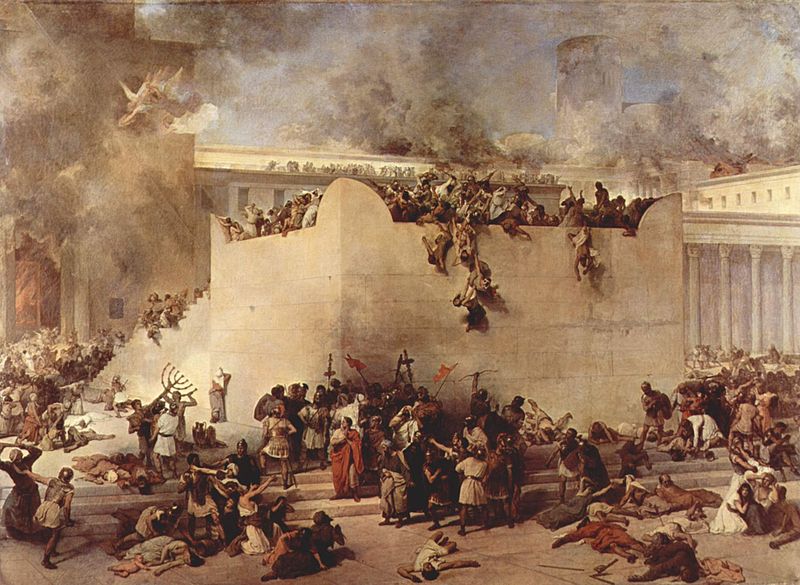
  • 70 CE Second Temple destroyed by Romans.800px-Francesco_Hayez_017
  • 135 CE Bar Kokhba rebellion put down and 100,000 Jews slaughtered at Betar.
  • 1096 CE First Crusade began by killing 10,000 Jews in first month and 1.2 million before it ended.
  • 1290 CE Jews expelled from England.
  • 1306 CE (10th of AV) Jews expelled from France.
  • 1492 CE (7th of AV) Jews expelled from Spain.
  • 1941 CE SS Officer Heinrich Himmler received approval to implement the ‘Final Solution,’ i.e. Holocaust.
  • 1942 CE Jews in Warsaw Ghetto deported for Treblinka (death camp).

And those are just the biggies….  Many more tragedies fell on Tasha B’Av or within a day or so.  Very strange…  and sad.

How am I, as a non-Jewish follower of the Jewish Messiah, to react? Continue reading “…Mourn with those who mourn.”