One of the benefits of the public stance I have taken regarding the Biblical positions of patriarchy and polygyny have been the number of people who have reached out to me with questions, support, or to share their story in how the Father opened their eyes in this challenging area. Currently, I am blessed to see the breadth of what the Father is doing as my connections and contacts now span the globe and cross multiple languages.
The recent video series on YouTube has been a particularly good connector with others, especially Torah teachers and keepers.
Benjamin, in a recent email conversation, shared some extremely insightful thoughts on rightly framing the argument. In his own words (and with his permission), here are the significant portions of one email:
Scholars are people trained in doing research, evaluating the data and reporting their conclusions. Normally that’s good when they are dispassionate and honest about what their data show. Sometimes, scholars have an agenda or bias and are selective about their data. That’s why on a given controversy, there are scholars to be found and cited on both sides of said controversy.
That said, we like to report the findings of scholars whose data supports traditional and biblical patriarchy.
The blogger over at Soil From Stone found these three scholars whose research shows that traditional patriarchy is the dominant form of marriage and family structure globally down through the centuries.
I spend more time exploring the Word and reading books than exploring the offerings out there by different Messianic teachers. So I confess that I am not up to date with everyone!
A friend of this blog mentioned to me Jay Carper at AmericanTorah.com and two of his articles specifically written about Mutual Submission. Pete Rambo has discussed this subject at his personal blog natsab.com and on his YouTubes. So I was curious what Jay had to say. Below are his two-part articles on Mutual Submission and the second one is a gem in particular!! He made some connections that I’d not put together myself. I’ll be exploring more of what Jay Carper has already written on his blog and learning from him.
Ok I’ll be honest…I had never heard this word before reading a blog post from a second wife in a polygynist family. So what IS it? Put simply, compersion is the OPPOSITE of jealousy! I’ve touched on jealousy before on this blog, but how do we actually rid our minds of this destructive emotion? Easier said than done, as they say. It takes work…INNER work. Just you, with the help of Yah, facing the ugly truth of your heart. I invite you to visit the original article, as the author does an excellent job of “showing her work”(remember math class? :))
Israel doesn’t waste time and gets right to his subject material. He opens with an introduction to his topic and says what his thesis or focus is with the book. He is addressing the “bible believers [who] condemn polygyny because they view the text with a Western lens” (Israel, page 2.)
There are five chapters in this book.
What is polygamy
The emergence of Christian Monogamy
Prevalence of polygyny among the ancient Israelites
Fallacious biblical arguments against polygyny
Polygyny as a remedy for social ills
In each chapter, typically consisting of a few pages, Israel is very concise and makes his points very well. In the first chapter, Israel goes over the definitions of each form of polygamy. A very, very brief survey of the first few centuries of the Christian era with respect to the promotion of monogamy is the focus of the second chapter. Another survey of biblical men who had plural wives in Ancient Israel is the topic of the third chapter. Israel takes on six arguments against polygamy and offers short rebuttals to each in chapter four. Finally, for societies where marriageable women outnumber marriageable men as in the African-American community, Israel says that polygyny definitely should be an option; that is promoted in chpater five. Footnotes and a bibliography are provided.
If I have to quibble about something with Israel, it would be his statements on page 4 that India and China have more women than men due to female infanticide. I suspect that he got that backwards and meant to say more men than women in these two countries. Perhaps he might correct this in a future edition.
At 51 pages, this book is very readable, packed with the basic information and at $10 essentially an expanded pamphlet that polygyny advocates can distribute. This would serve very well as a concise introduction to the subject, and then the interested reader can move to more advanced and more exhaustive treatments already available on the subject.
Monogamy-only is a common teaching of the Christian church, most Hebrew roots, and most of Judaism. But, is that a doctrine that invokes curses and the wrath of God? Really?
During Hooper’s discussion, he mentioned one scholar’s attempt to tie the ban to the activity of the Roman Catholic Church in the two centuries prior to the ban. Either Hooper or the scholar Zeev Flak (or both) didn’t make the very likely connection between cause and effect as shown in the quote below.
Another approach to isolating the stimulus which necessitated Rabbenu Gershom to issue his ban against polygamous marriage is to look towards the Christian society which surrounded the Jews of Germany. This line of thinking is reflected in Zeev Flak’s work Jewish Matrimonial Law in the Middle Ages. In his work Falk goes to great length to provide the context for Rabbenu Gershom’s ban, starting in the mid ninth century when Pope Nicholas I (858-67) campaigned against polygamy in the Catholic Church. By the tenth century bigamy was not longer a problem among Christians, however, the Church attempted to curb concubinage and divorce among its devotees.
Benji Hooper
Pope Nicholas I’s campaign was successful. But then the Church saw the rates of concubinage and divorce increase to the point where it required the attention of the Church!
It’s really hard not to see a direct cause and effect here!
Ban polygamy and concubinage and divorce increases! Mandatory monogamy does not bear good fruit.
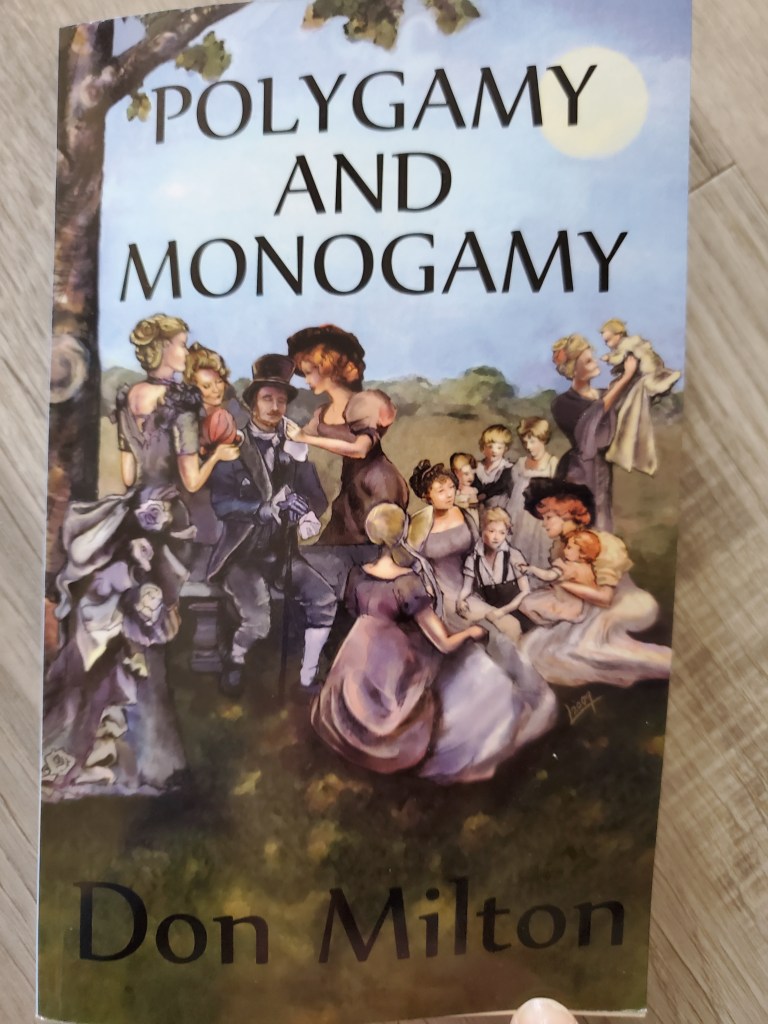
In 1869, a Christian philanthropist named James Campbell published a book titled The History and Philosophy of Marriage: Polygamy and Monogamy Compared. Filled with incredible wisdom and thought into natural law as well as Scripture regarding the societal effects of monogamy and polygamy. (Technically, the author always refers to polygyny, but uses the umbrella term polygamy.)





 11:3 Restoration